The Strategic Collapse Near Pokrovsk Konstantinovka
As of early May 2025, the Ukrainian defensive line along the critical Pokrovsk-Konstantinovka highway is showing signs of collapse under sustained Russian offensive pressure. Recent developments—most notably the entry of Russian forces into Novaya Poltavka and consolidation in Novoyelenovka—signal a significant shift in the battlefield dynamic, threatening the Ukrainian military’s operational cohesion in this sector.
Tactical Penetration and Flanking Success
Russian forces have executed a two-pronged advance, capturing Novaya Poltavka on one axis and Novoyelenovka on the opposite side of the critical highway. These settlements, lying within close proximity to one another, form a pincer around the remaining Ukrainian positions between Pokrovsk and Toretsk. The Ukrainian command, already under pressure from persistent drone and artillery strikes, appears to be struggling to coordinate a coherent evacuation of wounded and sending reinforcement.
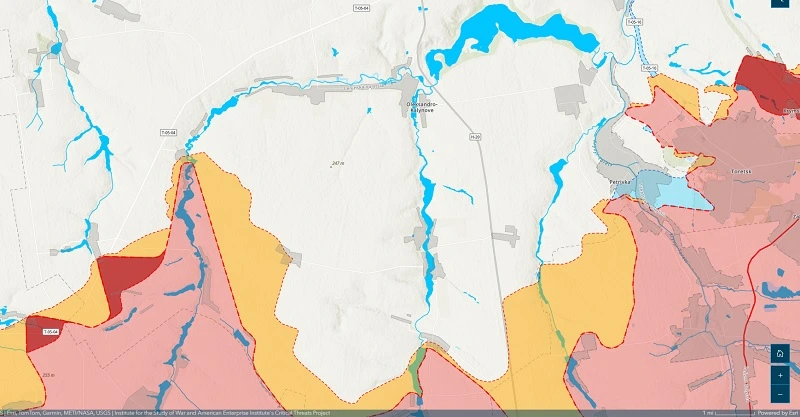
More concerning is the advance of Russian mine-clearing and mechanized infantry units from the Toretsk direction toward the water reservoir north of the Ukrainian grouping. With the distance from Novoyelenovka to the edge of reservoir being roughly seven miles, and only a single major supply route remaining open to Ukrainian forces, the situation bears the hallmark of a classic operational encirclement.
The Importance of the Water Reservoir Axis
Water features in military operations often serve as natural obstacles and lines of demarcation. The reservoir near Toretsk now plays a pivotal role in determining whether Ukrainian units can maintain a connection to the broader operational rear or become isolated in a de facto pocket. Should Russian forces reach the reservoir and cut off the remaining supply road, they would achieve a full operational envelopment of the Ukrainian grouping in the central Donetsk axis.
Such an encirclement would not only threaten the destruction or capture of Ukrainian forces in the salient but also disrupt the larger strategic depth of the Ukrainian defense line. The Pokrovsk-Konstantinovka highway has served as a key artery for logistics and troop movements; losing it would significantly degrade Ukraine’s ability to maneuver reserves and sustain operations westward.
Logistical Collapse and Morale Implications
Ukrainian logistics in this pocket are already reported to be under extreme pressure. Russian forces, with increased access to precision fires and reconnaissance, are effectively interdicting Ukrainian supply convoys and rear-area infrastructure. This degradation is likely to worsen should Russian artillery units establish fire control over the last remaining supply route.
The psychological impact on Ukrainian troops should not be underestimated. Encirclement, or even the credible threat of it, can have a cascading effect on unit cohesion, morale, and command effectiveness. Historical precedent—from the encirclement battles of WWII to modern conflicts—suggests that forces trapped without adequate resupply often face rapid degradation in combat effectiveness, even before a full encirclement is completed.
Strategic Consequences
Beyond the immediate battlefield gain, the fall of this section of the front would allow Russian forces to reorient toward key urban areas further west, such as Pokrovsk, and south to Konstantinovka with fewer defensive barriers.
For Ukraine, such a loss would necessitate a major operational adjustment. Reserve units would have to be rapidly repositioned, and political pressure could intensify for a more cautious approach, especially if losses in manpower and equipment are severe. Unless the Ukrainian command can execute a timely withdrawal or counterattack to secure supply routes, the forces inside the pocket face heavy casualties. European backers may also reassess the viability of certain Ukrainian objectives, further complicating Kyiv’s strategic calculus.